

If you have a young cat at home, you have probably wondered when kittens stop biting. The good news is that most kitten biting is normal, and it fades as your kitten grows and learns. Play biting and mouthing peak while your kitten is small, usually settle down a lot after the first year, and get much better once you teach your kitten what is okay to bite and what is not. This guide explains why kittens bite, when it eases off, and how to redirect those little teeth onto toys instead of your hands.
Why Do Kittens Bite So Much?
Biting is not one single thing. Your kitten bites for a few normal reasons all at once, and knowing which one you are seeing helps you respond the right way.
- Teething. Kittens have 26 baby teeth and grow 30 adult teeth. While the adult teeth come in, sore gums make kittens want to chew and bite more.
- Play and hunting practice. Cats are little hunters. Stalk, chase, pounce, and bite is a natural sequence your kitten needs to practice, even indoors in Kuwait where the summer heat keeps everyone inside.
- Learning boundaries. Kittens learn how hard is too hard from their mother and littermates. This is called bite inhibition.
- Communication and exploring. A kitten uses its mouth the way a baby uses its hands, to test and learn about the world.
Because biting is about more than teething, it does not simply switch off the day the adult teeth arrive. Some chewing can carry on for several months after all the adult teeth are in.
When Do Kittens Stop Biting and Teething?
Teething and biting follow their own clocks. Here is the rough teething timeline for most kittens:
- Baby teeth begin to fall out around 3 to 3.5 months of age.
- Adult incisors (the tiny front teeth) can come in as early as 3 months.
- Adult canines (the long fangs) come in around 5 months.
- Premolars and molars come in between 4 and 7 months.
- Most kittens have the majority of their adult teeth by about 5 to 6 months.
Play biting is a longer story. Rough, bitey play is most common in kittens and cats under 2 years old, and it is more likely to stick around in a young cat that lives alone with no other cat to wrestle with. So teething eases by about 6 months, but the playful nipping calms down more gradually as your cat matures and as you teach better habits. It is normal for a kitten to swallow the odd shed baby tooth. A little gum soreness or a spot of blood during teething is usually minor, but call us if the mouth bleeds a lot, smells bad, or a baby tooth stays put right next to a new adult tooth. That is called a retained tooth and it needs to be checked.
How to Redirect Biting Onto Toys, Not Hands
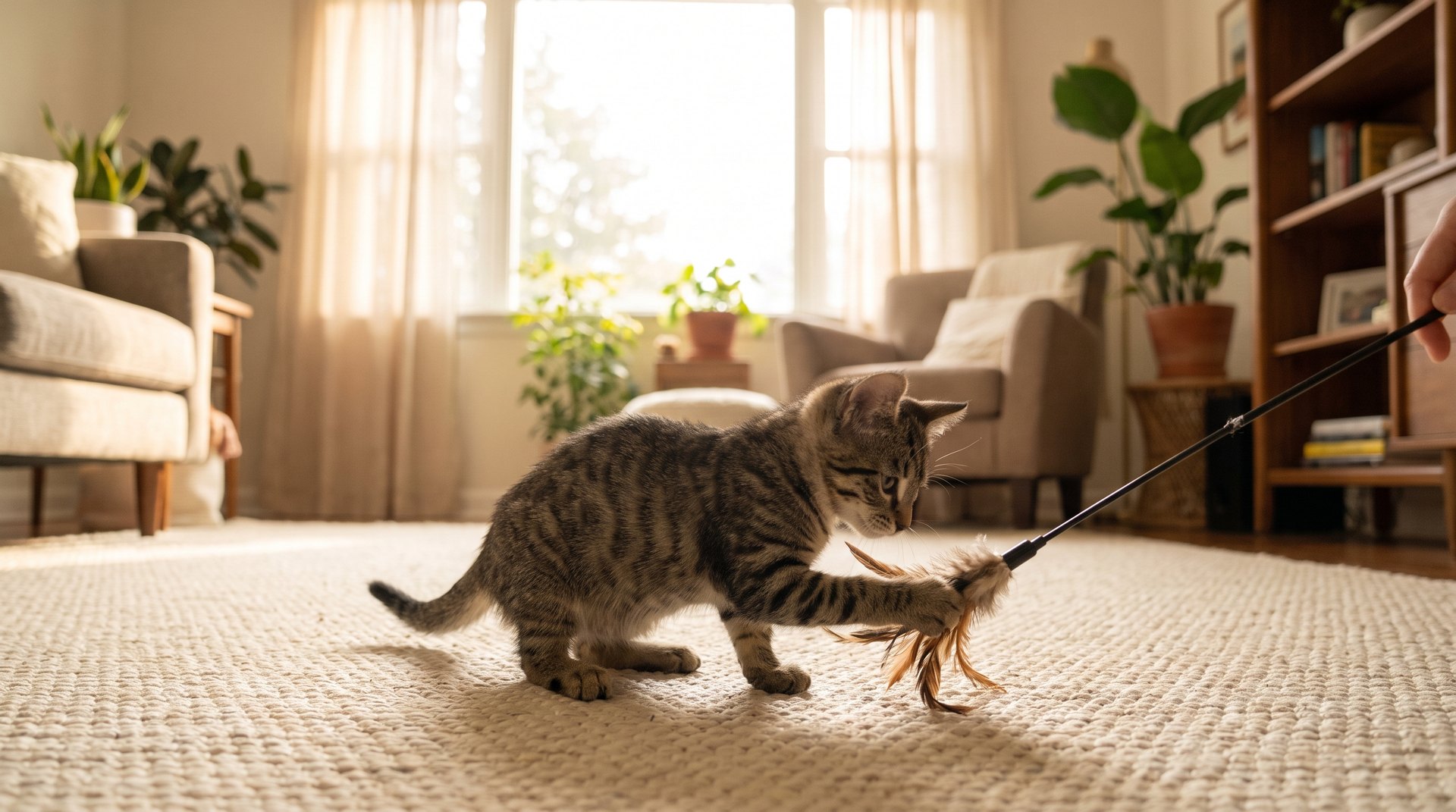
The simplest rule is this: your hands are not toys. Route every game through a toy so your kitten learns that teeth belong on the toy, never on skin.
- Use wand and fishing-pole toys. These keep your hand at a safe distance from teeth and claws, which makes them the best choice.
- Add feather teasers and throwable kicker or fleece toys so your kitten can grab, hold, and “bunny kick” something that is not your arm.
- Read the warning signs. Dilated pupils, a swishing tail, a low crouch, and a wiggling backside mean a pounce is coming. Toss or move a toy just before your kitten launches, so the toy becomes the target.
- Finish the hunt. Let play end on a real catch. If you use a laser pointer, switch to a wand or a toss toy at the end so your kitten actually catches something. A laser alone never lets them “win,” which can leave them frustrated.
- Play often. Several short play sessions a day, timed just before your kitten’s usual bursts of energy, drain that hunting drive onto toys. Rotate the toys so they stay interesting.
If teeth or claws touch your skin, calmly end the game. Freeze, take your attention away, and walk off, the way a mother cat turns away from a kitten that plays too rough. Do not yank your hand back fast, because a quick jerk looks like fleeing prey and invites more chasing. Make sure everyone in the family follows the same rule. If one person lets the kitten nibble fingers, your kitten cannot learn the boundary. Give it scratching posts, things to climb, and safe chew and kicker toys for its energy.
What Not to Do
Some common reactions make biting worse. Please avoid these.
- No physical punishment. Never hit, tap the nose, scruff hard, spray water, yell, or hold your kitten down. Punishment can cause pain and fear, make your kitten afraid of you, and can make aggression worse. Redirecting and withdrawing attention are the correct responses.
- No bare-hand play. Never use fingers or toes as bait or wiggle them to tempt a pounce. This teaches your kitten that body parts are prey and creates a mouthy adult cat that can really hurt.
- Do not isolate or scare the biting away. Long hours alone with no play outlet make play aggression worse, not better. The fix is more suitable play, not less contact.
- Do not consider declawing. It is a painful amputation, it does not fix the behavior, and it is condemned or banned in many places. Behavior training and good outlets are the right path.
When to See the Vet
Most kitten biting is normal play, but a few situations call for a checkup rather than more training. Book a visit if you notice any of these:
- A normally gentle cat suddenly starts biting.
- Your cat bites when you touch one particular spot on its body, which can signal pain.
- Biting comes with hissing, growling, or scared, defensive body language.
There is also a human health side to this. A cat bite that breaks the skin is a real medical concern, not just a scratch. Cat teeth are thin and sharp and push bacteria deep into the tissue, where infection can set in fast. If a cat bite breaks the skin, wash it right away with soap and running water, then see a doctor promptly. Do not wait for it to swell or turn red, because a cat bite can look fine at first and still get badly infected. Bites on the hand, and any bite to a child, an older adult, or a person with a weak immune system, need medical care quickly. Your doctor can advise on antibiotics and on whether a tetanus booster is needed. This is exactly why sending play to toys instead of hands matters for safety, not only for good manners.
Frequently Asked Questions
When do kittens stop biting?
Teething-related biting eases once the adult teeth are in, by about 6 months of age. Playful biting settles more slowly and is most common under 2 years old. With toys instead of hands and steady daily play, most owners see a big improvement well before then.
Why does my kitten attack my ankles and feet, especially in the evening?
Moving feet look like escaping prey, so they trigger the natural stalk-and-pounce instinct, often in the evening when your kitten has stored-up energy. Get ahead of it with a good play session before that usual witching hour, and keep a wand toy near the spots where the ambushes happen.
Should I get a second kitten to stop the biting?
A second, compatible kitten can give yours a proper playmate to wrestle and bite, which is a socially normal outlet. It is not a guaranteed fix, and a solo kitten can do very well with more scheduled interactive play from you. Think about your home and your time before adding a second cat.
My kitten was bottle-raised or taken from its mother early. Is that why it bites so hard?
Possibly. Kittens learn to soften their bite from their mother and littermates, ideally staying with them to about 12 weeks. A kitten orphaned or separated too early may never have learned that lesson and can play rougher. You can still teach it with consistent toy play, calm “game over” endings, and patience.
Kitten biting is a normal stage, and with the right toys and habits it gets much easier. If your kitten’s biting worries you, seems tied to pain, or came on suddenly, our team is happy to help. You can book online or give us a call to arrange a checkup and get advice made for your cat.